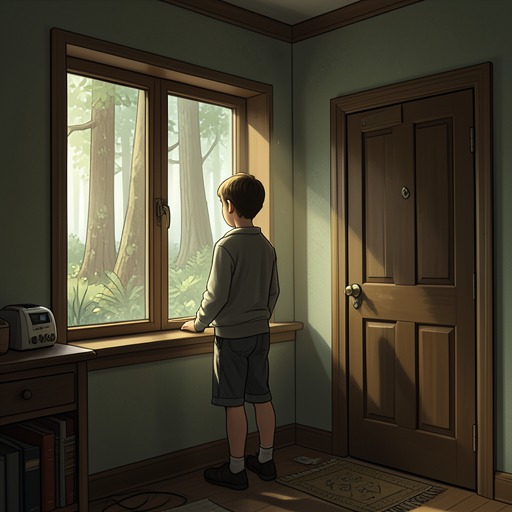
Freedom and the Cage Within
The Painted BirdFreedom and the Cage Within names the tension between the boy’s longing to choose his own path and the pull of belonging, protection, and family. At the moment his birth parents find him, he can still imagine escape, yet cannot make himself flee. A remembered Hare gives that conflict its starkest form: the animal is released from its cage, but returns because captivity has come to govern it from within.
Choice, Attachment, and the Pull Home
The boy’s parents have found him at the local Center, and the visible birthmark confirms his identity to them. As they bend over him, crying, hugging, and kissing him, he again considers running away. A crowded train could carry him somewhere no one would trace him. But escape would also put distance between him and Gavrila, whom he still hopes will find him. His hesitation is therefore not simply fear of being caught: he wants to remain reachable by the person whose world he has chosen to follow.
That hoped-for future is expansive in the boy’s imagination. He has pictured himself becoming a great inventor of fuses that change people’s color and living in the land of Gavrila and Red Army sniper Mitka, where tomorrow already seems present. Rejoining his parents threatens the end of those dreams, and with them a chosen identity built around movement, invention, and allegiance. Yet the boy also feels an inward force restraining him from flight. He compares himself to Lekh’s Painted birds, pulled toward their own kind by an attraction he cannot explain. The image makes kinship less a reasoned decision than a force that acts before he has settled what he wants.
The boy regards parental authority as a restriction that should no longer apply to him. Parents may be useful when a child is very small, he reasons, but a boy of his age should be free to select whom to follow and learn from. At twelve, he is old enough in his own estimation to choose his companions, but still young enough that his parents have a recognized right and duty to take him home. The conflict is sharpened by this mismatch: his sense of self insists on independence, while the law of kinship and the parents’ tenderness claim him as their child.
The Hare and the Cage Within
While his mother assures him that he will be happy with his parents and can do what he likes, the boy remembers a Hare caught by Makar. The large animal’s first response to confinement is vigorous resistance: it stamps, throws itself against the cage, and struggles beneath a heavy tarpaulin Makar uses to suppress its restlessness. After several days, the Hare gives up and becomes tame, even eating from the boy’s hand. The sequence makes captivity a process, not just a locked door: repeated defeat can alter what the captive expects and attempts.
When Makar gets drunk and leaves the cage door open, the Hare jumps out toward the meadow. At first it appears to have recovered the life the cage denied it. It sits alert, attending to sounds from distant fields and woods and to scents that belong to the open landscape. The boy understands these sensations as the Hare’s own: outside the enclosure, it briefly occupies a world beyond Makar’s control. But the animal does not make the expected dash into the tall grass. Its ears droop; it seems to shrink; and after one jump it turns back toward the hutch. It pauses and looks behind once more, then passes the other Rabbits and enters the cage.
The return is not caused by a closed door or an active captor. The boy closes the door only after the Hare has climbed inside, and recognizes that the gesture is unnecessary. The cage now binds the animal’s mind and heart and paralyzes its muscles: the confinement has become internal. Freedom had distinguished it from the other resigned, drowsy Rabbits, but it cannot sustain that distinction once released. The Hare’s retreat gives the boy’s own indecision a disturbing parallel. A person may have a way out and still find that the conditions of escape have been shaped by the experience of captivity.
Promises and the Limits of Freedom
The mother’s promise that the boy can do anything he wants seems to answer his fear of being controlled. She even offers to have a new uniform made as an exact copy of the one he wears, a gesture of accommodation that preserves the outward sign of his chosen identity. But the promise cannot restore the life he had imagined with Gavrila, nor can it erase the boy’s sense that becoming a real son will mean accepting care and obedience on grounds different from force. He is troubled by the prospect of being caressed and protected as well as by the prospect of having to obey.
The Hare story complicates any easy distinction between freedom and confinement. The animal is not physically prevented from leaving once Makar opens the cage, but it has been subdued enough to return. Likewise, the boy’s parents do not need to drag him away in the scene of recognition: his own attachment checks his imagined flight. His resemblance to the Hare is suggestive, not exact. The Hare returns to a familiar hutch after a history of coercion; the boy stays because an inner pull toward his family competes with his chosen loyalties and desire for independence. The parallel leaves open whether attachment is a homecoming or another enclosure.
A New Enclosure
After leaving the orphanage, the boy walks between his parents, feeling their hands on his shoulders and hair and experiencing their love and protection as smothering. The family’s apartment is crowded, and his parents have also adopted a four-year-old orphan. The boy questions whether he would be better off alone, waiting for Gavrila and wandering from village to village rather than settling into a life he finds predictable. His return to family therefore does not resolve the conflict established by the Hare; it gives it a new setting, where freedom is measured against care, domestic closeness, and obligations he did not choose.
The remembered animal furnishes the narrative’s most concentrated account of an inward cage. The boy does not simply celebrate flight, because the Hare’s open door ends in retreat; nor does he treat belonging as uncomplicated safety, because parental protection feels constricting. By placing the memory beside the reunion, the story makes freedom depend on more than the possibility of departure. The unresolved question is whether the boy can enter family life without surrendering the self he formed while wandering, or whether, like the Hare, he will find that the cage has already taken up residence within him.